Wolfson DPhil and team awarded ‘Block Allocation Group’ status for synchrotron experiment
Having recently completed her DPhil in Condensed Matter Physics as a Wolfson-Marriott Scholar, Wolfson College member Olivia Gough worked with fellow Wolfson members Professor Moritz Riede and Zhenlong Li to develop a novel experimental technique at Diamond Light Source using the MINERVA chamber, custom-built for in situ GIWAXS measurements of evaporated organic materials. Professor Riede leads the Advanced Functional Materials and Devices group in the Department of Physics, which focuses on vacuum-deposited organic solar cells.
These materials are promising for lightweight, flexible solar technologies, but their performance depends sensitively on their internal structure. This relatively specialised field of vacuum-processed organic electronics is attracting increasing interest due to its commercial potential, with similar deposition methods already widely used in the manufacture of OLED displays.
Olivia’s research focuses on understanding the structure of these organic semiconductor systems, alongside developing advanced methods for in situ characterisation. To address this, the team developed an X-ray experiment capable of tracking structural changes in real time as the materials are formed and processed within a controlled vacuum environment.
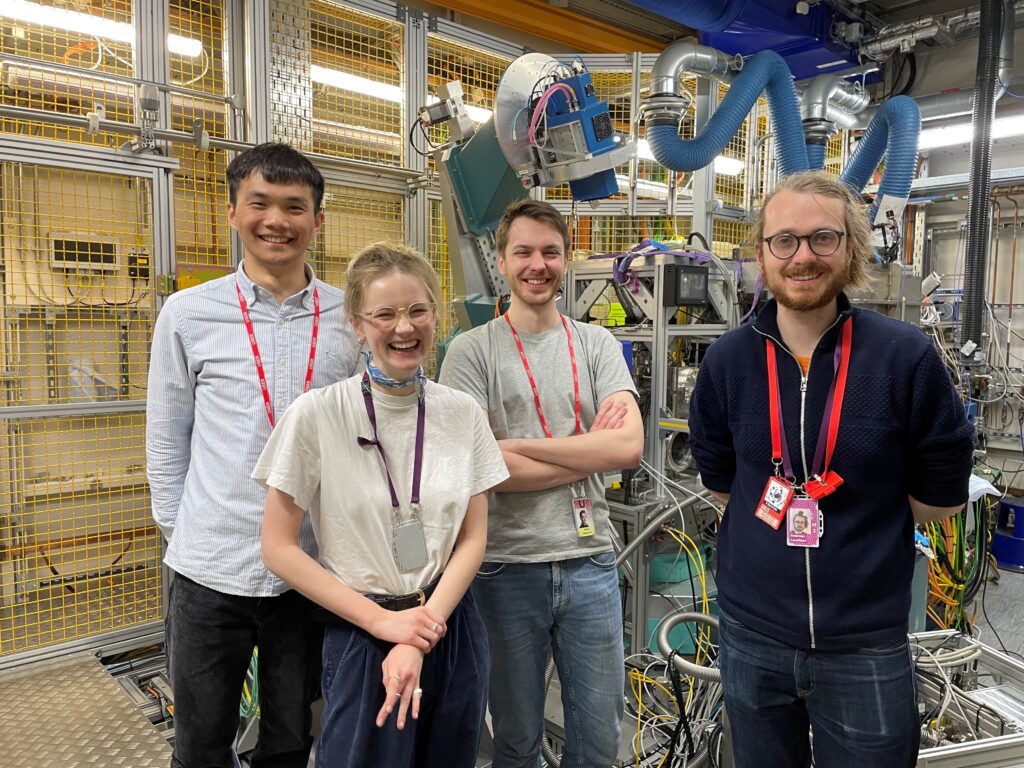
Olivia played a central technical role in the development of the MINERVA chamber, leading multiple beamtime campaigns and contributing to the design of experimental protocols used to collect complex in situ datasets. A key focus of her work has been making the technique accessible and adaptable for a broader user community. She developed flexible software tools for data processing and analysis, designed to accommodate a range of experimental needs, and authored detailed standard operating procedures to reduce the barrier to entry for new users working with this complex technique. Her work emphasises the importance of collaboration and the need to make advanced scientific tools accessible to a wider research community.
The method has recently been awarded Block Allocation Group (BAG) status at Diamond Light Source. This recognises the maturity and scientific value of the approach and enables external academic users to access the technique for their own research projects. Collaborators from several institutions, including Imperial College London, TU Dresden, the University of Sheffield and the University of Florence, are now using the method across a range of applications, including organic transistors, quantum dots and spintronic materials.
Reflecting on her time at Wolfson, Olivia highlights the importance of the college’s interdisciplinary environment and its strong engagement with research addressing the climate crisis. She notes that the opportunity to engage with leading voices in sustainability, alongside the support provided by the Wolfson-Marriott Scholarship, played an important role in shaping both her research direction and broader interest in developing technologies for energy technology.