Meet a Wolfson Scholar: Gabriel Maxemin
Gabriel is one of two Wolfson students to be awarded the Tim & Elaine Rolph Scholarship in Climate Change.
Tell us about your research field and its applications.
I am pursuing a DPhil in Atmospheric, Oceanic and Planetary Physics, within which I get to learn from experts in space instrumentation, weather forecasting, climate modelling, and much more. My subdepartment brings together people studying all sorts of planets and objects in space, and I happen to focus on Earth!
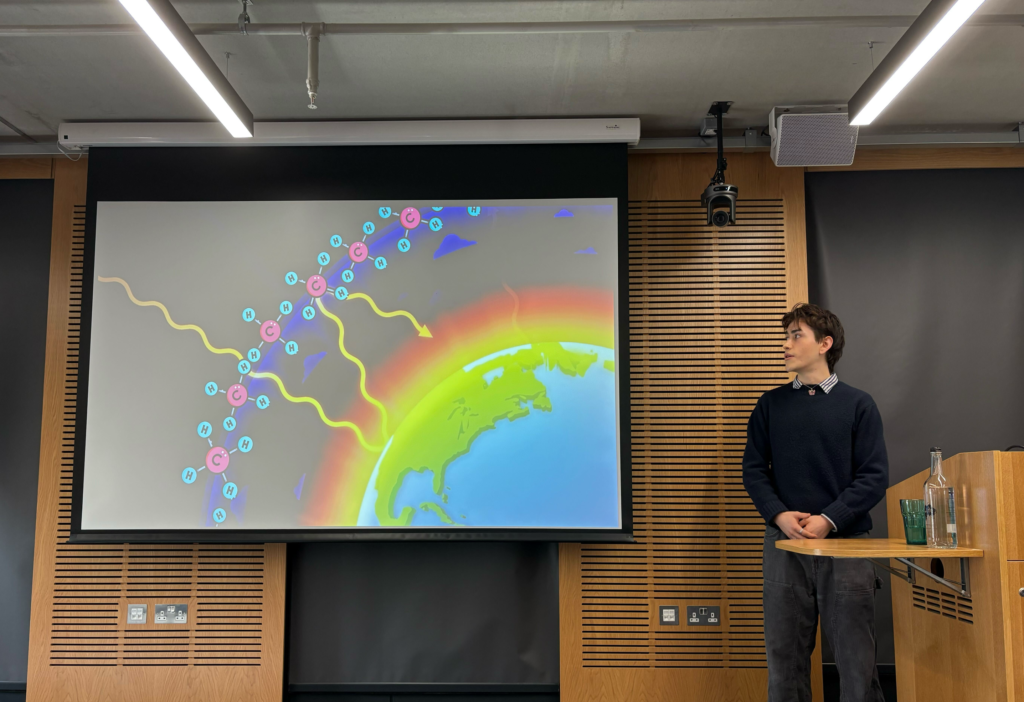
I work within the Earth Observation Data Group using remote sensing to study biomass burning in the tropics. This means that I look at events like wildfires with data that comes from a distance, typically from satellites, as opposed to on-site observations. Many fires experience two types of combustion: flaming and smouldering. Satellites have a hard time detecting smouldering because of its lower temperature signatures. These types of fires creep around as dense smoke and are often obscured by forest canopies and clouds. My work aims to use a combination of satellite products and models for a more complete understanding of the gases and particles within smouldering plumes.
Smouldering combustion has a notable impact on air quality, releasing large amounts of pollutants into the air, particularly carbon monoxide and particulate matter. Alongside their health and ecological effects, these emissions also play a significant role in atmospheric composition and contribute to climate change.
You’re originally from Mexico. Do you think your heritage plays a role in your decision to pursue this research? How did you come to work in this field and what was your education path up to this point?
My background definitely plays a part in my research! Within my field, we often see how local environmental changes have larger impacts, making it clear that climate change is a global issue affecting us all. However, the picture is more nuanced when thinking about imbalances in the climate story. Often overlooked are communities most vulnerable to climate change and areas suffering from data sparsity.
I come from a desert environment where climate change is projected to contribute to extreme heat, strained water resources, and a loss of crops. Beyond this, I’m from a US-Mexico border town where idling vehicles made me acutely aware of air quality issues which are often neglected. And while my work now doesn’t look at Mexico directly, it does aim to improve our understanding of an environmental phenomenon affecting vulnerable populations.
The idea that I could contribute to this field didn’t come until just a few years ago. I completed my undergraduate studies at Harvard University, where I pursued a joint concentration in 1. Earth and Planetary Sciences and 2. Chemistry and Physics with a secondary in Astrophysics. There, I was fortunate to work across different labs where I realised that research was something I could even pursue and that having a different background and perspective is an asset in science! I’ve worked on landfill emissions, looked at galaxy spectra, conducted magnetic analyses of brain samples, and spent time on a plethora of other projects that eventually led me to my current field. I became inspired by people from all over the world solving global problems together, drawing me to a PhD where I’m able to be a part of that.

Tell us about the Tim & Elaine Rolph Scholarship.
I feel very grateful to have received the Tim & Elaine Rolph Scholarship in Climate Change. It means a lot that the funding supporting my work recognises climate change as a real threat and that it grants merit to work within this discipline. Learning about the personal connection that Tim and Elaine have to the Earth, I was reminded of how much of my motivation for this type of work is rooted in personal anecdotes and the bond that each individual holds with an environment that we all share.
What role does Wolfson play in your Oxford experience – in terms of your research, but also socially, etc.?
Seeing the Wolfson Minibus pass by and tout “THE NATURAL HOME FOR GRADUATES,” I remember that I’m lucky to have access to two separate yet connected worlds: Oxford and Wolfson. I’m able to move between the rush of the city and the tranquility of Wolfson’s green outdoors. Wolfson has been a leader in its decarbonising efforts, and it makes my strolls through the meadows much more peaceful knowing that the College is committed to protecting the beautiful nature and wildlife.
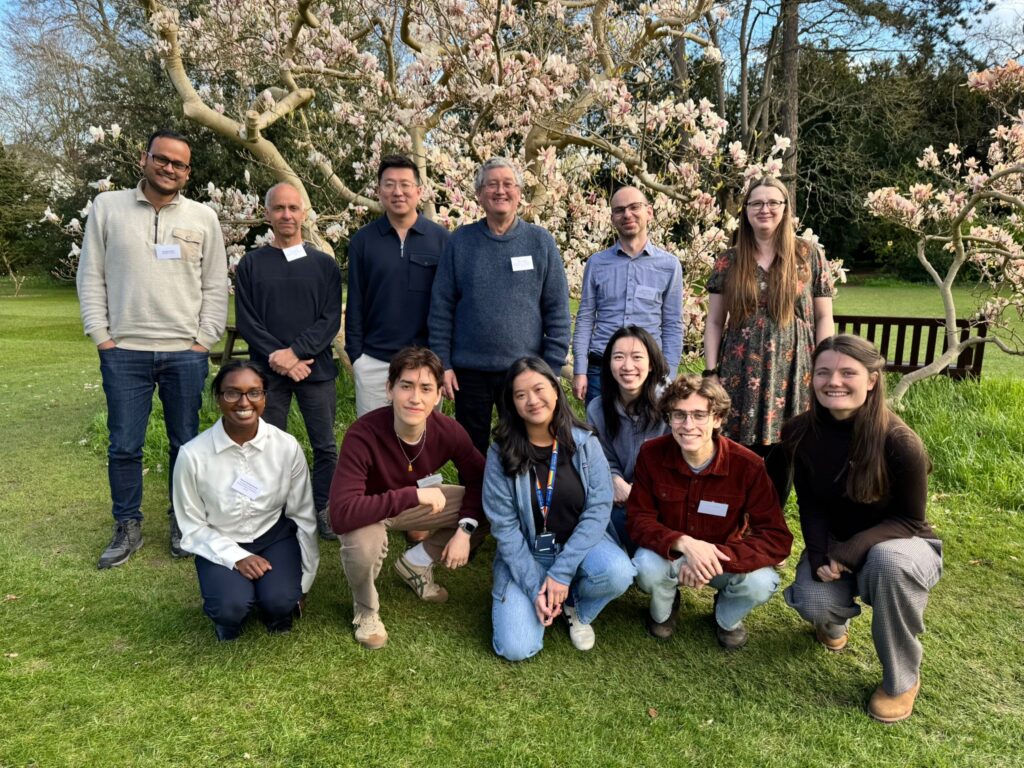
Wolfson has also been very special socially. Finding friends became so much easier with the amount of friendly and welcoming people around. Because the Wolfson community is so vast and diverse, it has been a gift to be able to bond with people over such different facets of our lives. Though I pride myself in adhering to a strict bedtime, my friends make it hard to not continue chatting and laughing late into the night.
What do you enjoy most about studying in Oxford, and at Wolfson more specifically?
At Oxford, I get an incredible amount of flexibility when planning my day. I can make my day’s story one that is very academic, hopping between a seminar, my lab, and one of dozens of libraries. Or I can visit local shops, pay a regular visit to the Oxford Tea Appreciation Society, try out a new sport, and walk around plenty of beautiful streets.
Wolfson provides one of the University’s biggest strengths, which is its expansive international community. I have found that this diversity of backgrounds manifests itself with a culture that is welcoming and celebratory of our differences at Wolfson. The College allows a separation from work, allowing me to hang out with friends whose hobbies, interests, and studies are completely different from mine. Between Wolfson, the University, and the city itself, it is difficult to be bored.
To learn more about the wide range of scholarships that Wolfson offers, click here.