Wolfson student elected Oxford University Students’ Union President for Postgraduates
We sat down with David Quan 权丁文, following his election as President for Postgraduates at the Oxford Students’ Union.
Congratulations on your election as President for Postgraduates! Tell us about your campaign, and what it means to you to be elected.
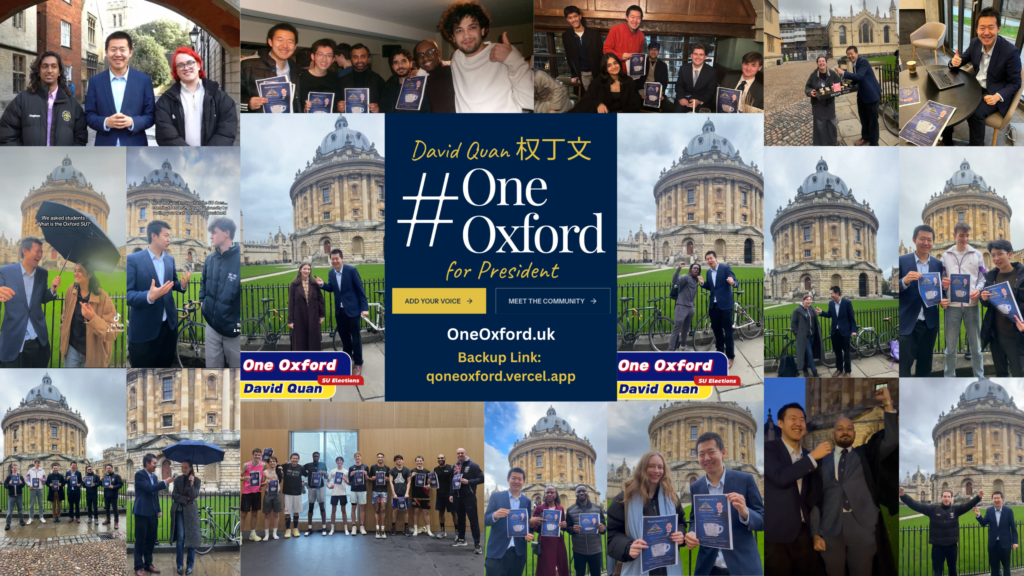
Our “One Oxford” campaign began with One question. Over conversations with students across colleges, I kept asking: “What’s the One thing you would change about Oxford?” More than a hundred students from thirty-plus colleges featured across our Radcliffe Camera street interview videos, social media, and campaign website, and from those discussions, a chain of aspirations emerged: What if we have only One Oxford, precious, worth fighting for? What if we have One standard of support and transparency, regardless of background, college, or department? What if even One student matters? What if One Oxford means not just postgraduates and undergraduates, but also alumni, staff, and locals?
University-wide campaigns are indeed team efforts. Our #OneOxford movement was carried day-to-day by a team of six students – Arsh Patankar, Jerry Jin, Tim Mears, Jamie Potter, Julia Magin, Tara Scully, four of them first-years – through freezing nights, posters before tutorials, weeks of chats past midnight, and messages at 2am to keep each other going! I also stood on the #DemandMore ticket alongside Zagham Farhan (Undergraduate) and Henry Morris (Welfare), with Chloe Pomfret helping throughout. They have become dear friends.
Voting takes place across the whole Oxford community (all students, including undergraduates, are eligible to vote) and we achieved 46.4% of first-preference votes in a four-candidate race that included the incumbent. My team now have a responsibility that our broader Oxford community have trusted us with – to keep listening, to keep showing up, to keep building and serving. It was never about One candidate, but One community. We’re One Oxford!
You spent your early professional career at Goldman Sachs. What has been your experience so far of the Oxford community, especially returning to university as a student? What learnings will you take from that business chapter into the SU President post?
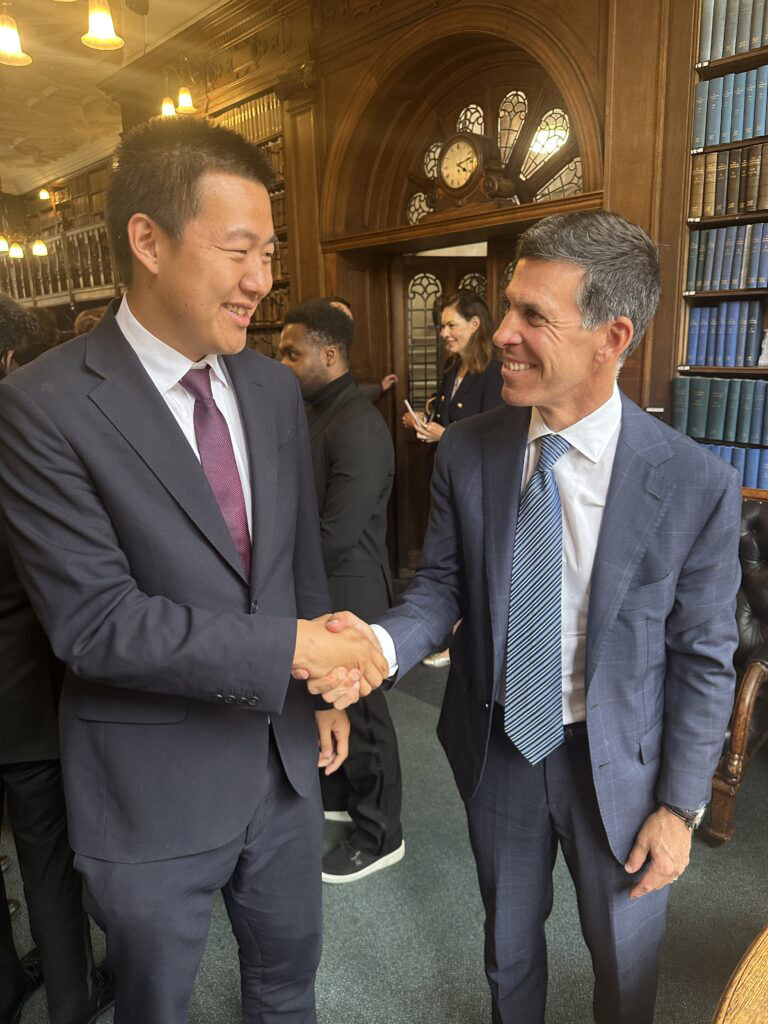
My early career at Goldman Sachs in London was humbling and formative. Coming out of undergraduate into a new field, a new city 10,000 miles from home, I faced a steep learning curve – professionally and personally. But what helped me through were the people – the colleagues, the mentors – and everything they modelled and taught me. Selected to the EMEA Analyst & Associate Council, I worked daily with and was mentored by exceptional colleagues across New York, London, Singapore, Frankfurt, Bengaluru, The Hague, and beyond – across cultures and disciplines, addressing clients’ commercial problems that take many minds to solve. Working alongside external and in-house legal advisers on transactions and projects also opened my eyes to how complex commercial decisions are structured, negotiated, and navigated – the drafting, the coordination, the precision required at every step, and how often the boring, mundane, and minute things behind-the-scenes matter the most. Those years grounded me in the demands of excellence, partnership, and what client service means. Away from my desk, I was fortunate to captain the Goldman Sachs basketball team and sing in the firm’s choir, finding community along the way. Recently, I helped host Goldman Sachs’ President and COO John Waldron and his team at Oxford – a quiet meeting of chapters.
Coming back to university after working full-time in the City let me bring industry rigour to academic questions, and academic depth to how I think about leadership and service. That curiosity and those learnings have continued at Oxford, through the Oxford Law Society, for instance – where mentorship, events, workshops, and conversations with practitioners across the City have shown me, from another angle, how commercial and legal expertise shape complex business decisions. As the elected Mentorship Officer, I tried to pay forward what I had been given by personally recruiting and matching 61 mentees with 42 mentors, the largest scheme in our history and the first to match all mentees, with senior practitioners from across the City and beyond.
What I take into the SU role, then, is the learning that this kind of work – serving people and institutions through decisions that matter, often under uncertainty, and coordinating across stakeholders – requires nothing less than excellence, partnership, integrity, and showing up again and again.
You’re completing an MSc in AI Education (Digital and Social Change) at Wolfson. Tell us about your dissertation, and what Wolfson has come to mean to you for your studies and student life.
My dissertation asks what AI literacy means now that AI is becoming agentic, and what it takes to develop it well on an individual, organisational, and societal level. Drawing on Amartya Sen’s capabilities approach, I treat AI literacy as a capability, not a resource, because access alone does not necessarily translate to more equitable outcomes. Practically, I designed an AI literacy curriculum and ran a workshop teaching Oxford and Cambridge students Claude Code, tracing where the work happens – including in prompt formulation, error recovery, verification, and accept-or-reject calls. I am thinking through what people, institutions, markets, policy, and the law can do, so the gap between access and capability does not become the next inequality.
Wolfson has felt like the right home for my academic and social life. Two moments outside the studies capture what the College has come to mean for me as a community:
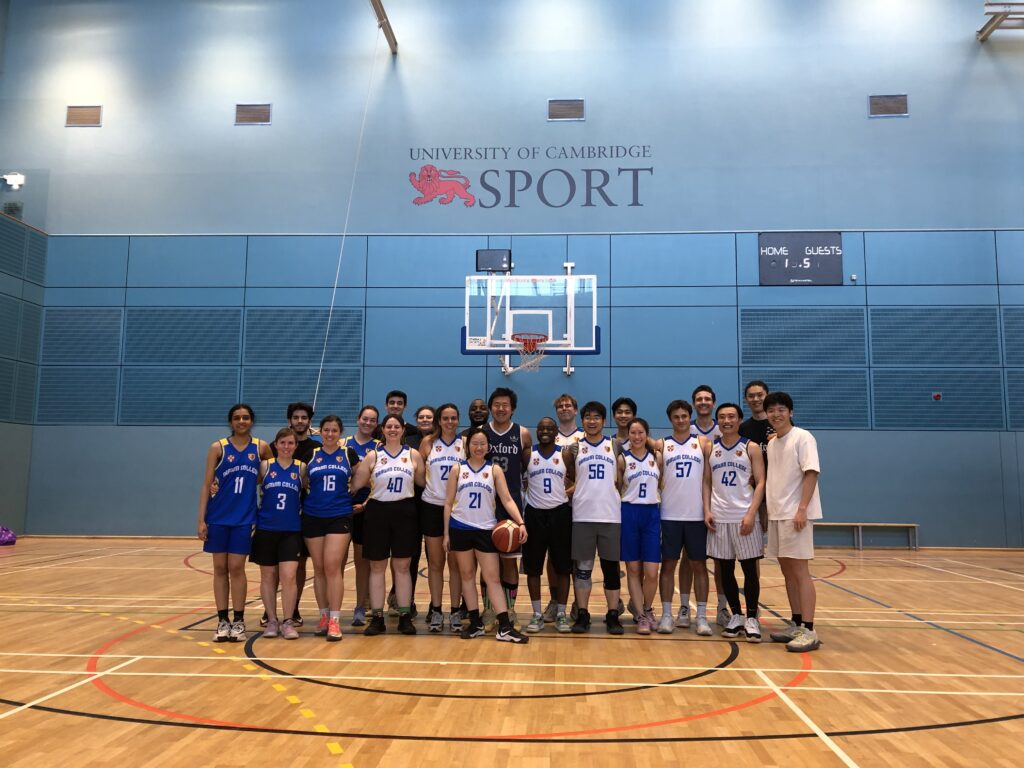
First, earlier this term, fifty of us travelled together to our sister college Darwin College, Cambridge, for the Oxbridge Sports Day. We played a variety of sports in the morning, before dinner in Hall at night, across a table of people we would otherwise never have met. It also helped our Wolfson basketball team bond before we went on to win our first intercollegiate Cuppers championship. That kind of cross-institutional ease, combined with the communal spirit of fun and competitiveness, is Wolfson at its best.
Second, I interviewed our College President, Sir Tim Hitchens, over two and a half hours for the 112th episode of my ‘Coffee’s on Me, David Quan 权丁文 Podcast’ – recorded on the banks of the River Cherwell at Wolfson. Sir Tim and I share not just an undergraduate Cambridge bridge – he read English Literature at Christ’s College, whilst I read Education Policy and International Development at Clare College – but also childhood time in Adelaide, Australia. When I asked Sir Tim what he was proudest of in his Wolfson Presidency, he said it was maintaining the spirit of friendliness among students and Fellows. He also chairs Oxford’s Joint Committee on Student Mental Health, a remit that sits alongside the SU role I am stepping into. That kind of approachable, thoughtful leadership modelled across our college is what makes Wolfson, Wolfson.
The College’s motto – “Humani nil alienum,” nothing human is foreign to me – is the line I keep returning to.
Tell us about what service means to you, in this role and beyond, and how that meaning has been shaped by those who came before.
Service, I have come to learn from those who have positively influenced me, is both personal and systemic – in how we carry each other, and in how we shape the institutions, mechanisms, and structures that move us forward. For me, it takes its shape from the people who carried me through my childhood: family, friends, role models, and leaders. My parents taught me family is bigger than the one we are born into. My community across three continents carried us through my late mother’s illness with meals, rides, and kindness. My late grandfather pioneered private education in China, founding a mission-driven university for tens of thousands of children who would not otherwise have studied at university; he believed young people are like water at 70 degrees, and with a little firewood, they boil and flourish. That inheritance is what I take into the responsibilities ahead, standing with people and institutions through decisions that matter, often under uncertainty and trying circumstances.
In my year-long student leadership role at St Peter’s College (Saints) in Adelaide, Australia – much like the sabbatical year with the Presidency ahead – I strove to care for and get to know each and every student, and naturally their families. I knew 1,500-plus students by name, which helped me not only with forging meaningful relationships, but also with the governance and managerial aspects of the role. While the Oxford community is far larger now – with 27,000+ students – the same principle of leading through service and through everyday interactions will ground me. What we hope to build, alongside Zagham Farhan, Roxi Rusu, and Catherine Kola-Bologun, is an Oxford Students’ Union that students actually turn to – one that hears them, includes them, and represents them where decisions are made. I appreciate that no leader alone has every answer; the work of representation, advocacy, and consultation is to keep showing up, listening, and serving – together. Everyone matters – we’re One Oxford!