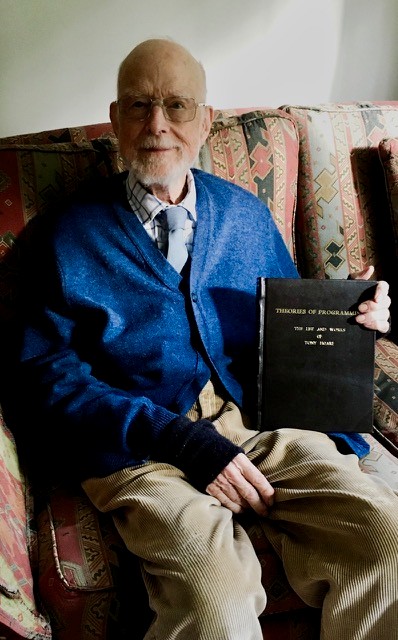
Wolfson Emeritus Fellow Professor Sir Tony Hoare Dies
It is with great sadness that the College has learned of the death of Professor Sir Charles Anthony Richard (Tony) Hoare, who died peacefully at home on 5 March 2026 at the age of 92, surrounded by his family. Sir Tony was a Governing Body Fellow from 1977 to 1999 and subsequently an Emeritus Fellow from 1999 until his death.
Tony began his career in 1960 as a programmer at Elliott Brothers Ltd, a small British computer manufacturer. There, he led a successful project to develop one of the earliest compilers for ALGOL 60, later becoming Chief Scientist in the company’s research division.
He moved into academia in 1968 as Professor at Queen’s University Belfast, where he served until 1977 before taking up a chair at Oxford. At both institutions, he founded the first undergraduate and graduate degree programmes in computer science, as well as several joint degrees with the Mathematics and Engineering faculties. At Oxford, he also established a pioneering part-time MSc in Software Engineering designed for students working in industry.
Here, Professors Nobuko Yoshida and Samson Abramsky, Wolfson Fellows and Tony Hoare’s successors in the Christopher Strachey Professorship of Computing reflect on his impact on the field:
“Tony Hoare’s invention of Quicksort was a landmark in algorithm design, demonstrating how structural clarity can yield both elegance and efficiency. Its influence has been immediate and enduring. Yet his deeper and more consequential contribution was Hoare Logic. By introducing a precise mathematical framework for specifying and proving program correctness, he established correctness as a formal property subject to proof, not merely an empirical expectation.
Hoare Logic transformed programming from a craft reliant on ad hoc testing into a discipline grounded in specification and verification. It laid the foundations for formal verification, program semantics, and the construction of dependable, safety-critical systems. Tony Hoare decisively bridged theory and practice, setting standards of rigour that continue to define computer science.” Nobuko Yoshida (GBF)
“Tony Hoare was an iconic figure in computer science whose work had a profound and lasting influence. His fundamental contributions include Hoare Logic for reasoning about programs and the Communicating Sequential Processes formalism for concurrency, among many others.” Samson Abramsky (EF)
After retiring from Oxford, Tony joined Microsoft Research, first as a consultant and later as an Honorary Visitor, continuing to contribute to the field he helped to shape.
Over the course of his career, Tony received many distinguished honours. Most notably, he was awarded the A. M. Turing Award from the Association for Computing Machinery in 1982, the most prestigious international award in Computer Science, recognising his fundamental contributions to the definition and design of programming languages. He received the Kyoto Prize for Advanced Technology in 2000, an award made only once every four years, and the IEEE John von Neumann Medal in 2011, one of the highest international distinctions in engineering.